
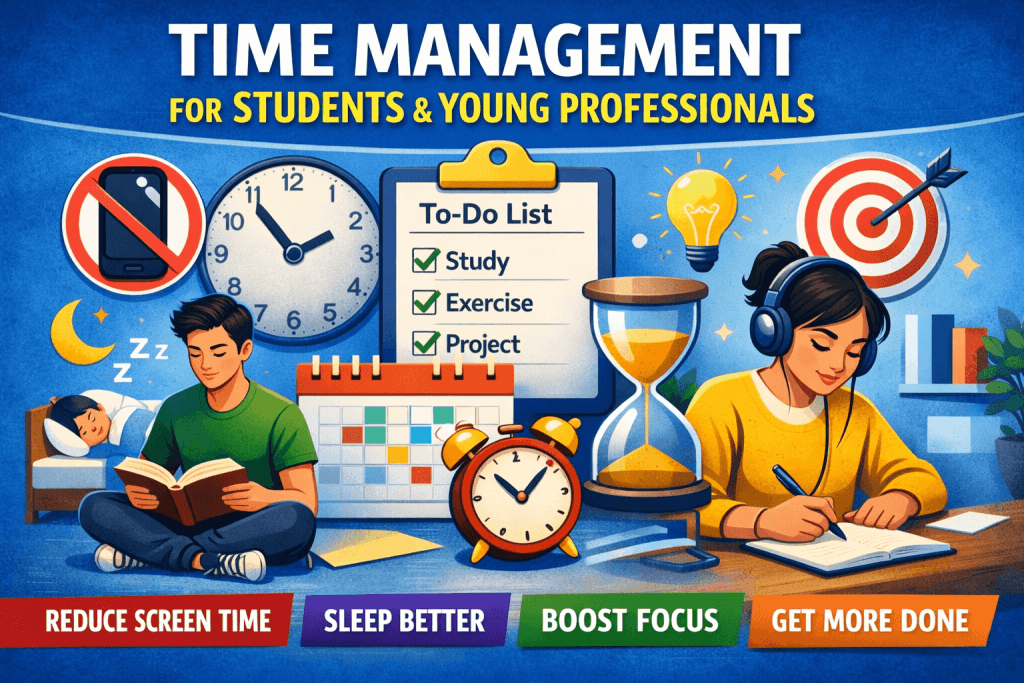
Time management is not just about managing hours. It is about managing your energy, attention, and habits.
Many students and young professionals struggle with:
- high screen time
- low sleep
- constant distractions
- lack of focus
- unfinished tasks
The result is stress, poor productivity, and slow personal growth.
If you are facing these challenges, this guide will help you take control of your time and build a more focused life.
To understand how time management connects with confidence, habits, and overall personal growth, explore the Personality Development Guide for Students and Young Professionals.
What Is Time Management?
Time management is the ability to use your time effectively by prioritizing tasks, avoiding distractions, and maintaining consistent habits.
It is not about doing more work. It is about doing the right work at the right time.
The Real Problems Behind Poor Time Management
Before fixing time management, you need to understand the root problems.
1. High Screen Time
Scrolling social media for hours reduces your attention span and wastes valuable time.
Example:
You pick up your phone for 5 minutes and end up spending 1 hour without realizing it.
2. Low Sleep
Poor sleep leads to:
- low energy
- poor focus
- slow thinking
Without proper rest, even simple tasks feel difficult.
3. Constant Distraction
Notifications, messages, and multitasking reduce deep focus.
Your brain keeps switching tasks, which lowers productivity.
4. Lack of Clear Goals
When you don’t know what to do, you waste time deciding instead of acting.
Why Time Management Matters
Good time management helps you:
- complete tasks on time
- reduce stress
- improve focus
- build discipline
- create more free time
It also plays a major role in personality development and self-confidence.
For a complete roadmap on personal growth, you can explore the Personality Development Guide for Students and Young Professionals.
Practical Strategies to Improve Time Management
1. Use the 3-Task Rule (Clarity First)
Every day, choose only 3 important tasks.
Example:
- Study for 2 hours
- Complete one project
- Exercise for 30 minutes
This removes confusion and improves focus.
2. Control Your Screen Time
Start by tracking your daily screen usage.
Then:
- turn off unnecessary notifications
- use app timers
- keep your phone away while working
Example:
Keep your phone in another room while studying.
This simple change can double your focus.
Time management is closely linked with personality development. You can learn more in Top 15 Personality Development Tips to Boost Your Confidence and Growth.
3. Follow the 60–10 Focus Rule
Work for 60 minutes, then take a 10-minute break.
During work time:
- no phone
- no social media
- no multitasking
This builds deep focus.
4. Fix Your Sleep Routine
Sleep is not optional.
Create a simple routine:
- sleep at the same time daily
- avoid screens 30 minutes before bed
- wake up early
Example:
Sleeping at 11 PM and waking at 6 AM improves energy and productivity.
Building strong daily habits is essential for managing time effectively. You can explore practical routines in 10 Daily Habits That Can Transform Your Life.
5. Use the Time Blocking Method
Divide your day into blocks.
Example:
Morning → Study / Work
Afternoon → Tasks / Meetings
Evening → Learning / Exercise
Night → Reflection / Planning
This gives structure to your day.
6. Eliminate Distractions
Identify your biggest distractions.
Common ones:
- social media
- unnecessary conversations
- multitasking
Solution:
Create a distraction-free environment.
Your mindset plays a key role in staying focused and avoiding distractions. Learn how to build a positive mindset in The Power of Positive Thinking.
7. Plan Your Next Day at Night
Before sleeping, write:
- 3 main tasks for tomorrow
- schedule for the day
This removes decision fatigue in the morning.
Real Life Example
Rahul, a college student, struggled with:
- 6+ hours of screen time
- late sleeping habits
- low focus during study
He made simple changes:
- reduced screen time by 2 hours
- started planning his day
- used time blocking
Within 30 days:
- his focus improved
- study time increased
- stress reduced
Small changes created big results.
Daily Time Management Routine
You can follow this simple routine:
Morning
- wake up early
- exercise or read
Day
- focus on important tasks
- avoid distractions
Evening
- review progress
- learn something new
Night
- plan next day
- sleep on time
Common Mistakes to Avoid
- trying to do too many tasks
- multitasking
- ignoring sleep
- no clear priorities
- overusing mobile phones
Avoiding these mistakes can improve your productivity significantly.
If you want to understand how small changes can transform your life, read my Personal Growth Journey and the lessons I learned along the way.
Final Thoughts
Time management is not about being busy. It is about being productive and focused.
If you fix:
- your screen time
- your sleep
- your distractions
- your habits
you can completely transform your daily life.
Start small. Stay consistent. Improve daily.
FAQ
Focus on 3 important tasks daily, reduce screen time, follow a fixed schedule, and avoid distractions.
Turn off notifications, set app limits, and keep your phone away during work or study.
Good sleep improves focus, energy, and productivity, helping you complete tasks faster.
Time blocking and the 3-task rule are simple and highly effective methods for managing time.

Abhinav Sharma is a writer focused on personality development, mindset growth, and helping students build confidence and life skills.